2026-06-24
GolemWorkers vs Replit Agent: Decide Where the Control Loop Lives
Compare Replit Agent’s project-and-deployment loop with GolemWorkers’ persistent-worker loop across source of truth, checkpoints, runtime ownership, rollback, and handoff.

“Agent” is doing too much work in this comparison. In Replit, Agent is primarily the builder inside a project that becomes an application, automation, or deployable agent. In GolemWorkers, the agent is the durable worker: the workspace, tools, schedules, and communication path remain available for the next assignment.
That difference is more useful than a feature contest. Replit Agent can now create far more than a browser prototype. Its current documentation covers applications, scheduled and webhook-driven automations, and autonomous agent applications. GolemWorkers can work on code, but it is not merely an app generator wearing a chat box. The products overlap at “AI can change code” and diverge at the place where continuity lives.
Agent is an overloaded word
Names mislead.
Two loops, two homes.
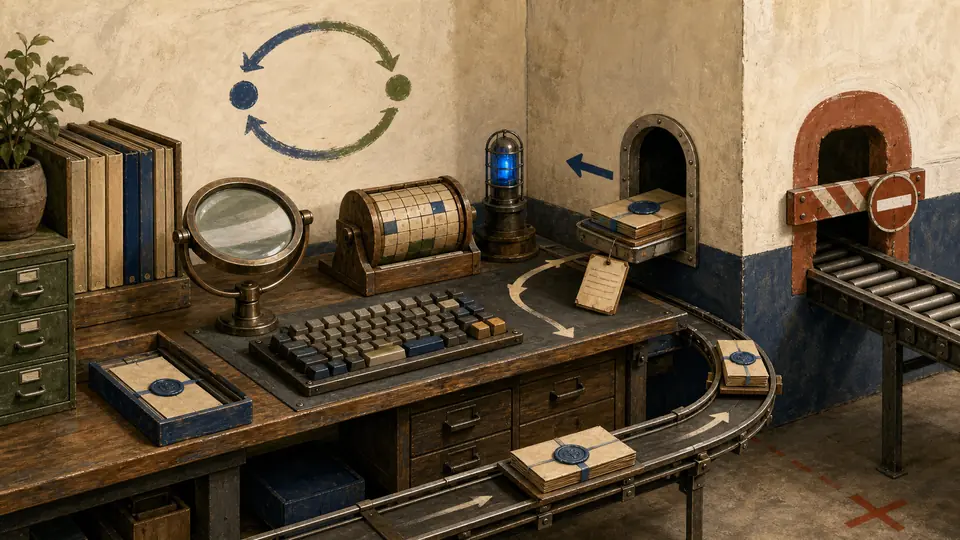
A useful comparison starts by removing the product names. Imagine two loops.
The first loop begins with an idea, plan, or issue. It writes and edits a project, checks the result, creates recoverable checkpoints, and publishes an artifact. A later turn returns to that same project. The code, project history, environment configuration, deployment settings, and application state provide continuity.
The second loop begins with a work packet. It opens the same durable workspace, uses approved tools across repositories or services, records evidence, delivers a result, and waits for the next message or schedule. A later run returns to the worker's files, memory, browser session, tool policy, and operating notes. The worker is the continuity mechanism even when the target system lives elsewhere.
Replit is capable of recurring software because it can build automations and autonomous agent applications. GolemWorkers is capable of producing software because its worker can use a terminal, browser, files, and repositories. Neither sentence settles the purchase. The question is which loop the team intends to own.
The Replit loop returns to an application
Source survives.
The artifact comes first.
Replit Agent's current overview describes a project-building process: a user describes the result, Agent prepares a task list, writes code, configures infrastructure, checks its work, and creates checkpoints. The artifact is not a transcript. It is a Replit App that can be previewed, revised, synchronized with Git, and published.
That project center is valuable. A founder can turn acceptance criteria into a working product surface without assembling a local toolchain. An internal-tools team can keep code, runtime configuration, preview, and deployment close together. A developer can inspect the generated source instead of receiving an opaque automation recipe.
The word “app” should not be read narrowly. Replit's automation examples describe full-code applications triggered by webhooks, cron schedules, or API polling. Those applications can call connected services, process data with AI, and perform actions. The source remains customizable and version-controlled. Replit also documents building and publishing autonomous agent applications with scoped tools, plan review, testing, and scheduled deployments.

This makes Replit the more direct first test when the desired output is a deployed application, a customer-facing prototype, or automation whose source and runtime should stay together. The build loop and the artifact loop are intentionally close.
Close does not mean automatic. Replit's own material recommends specificity, plan review, testing, and checkpoints. Generated code still needs a security boundary. Connectors still carry authority. A scheduled automation still needs idempotency and reconciliation. Publishing turns a promising build into a running service; it does not make the service self-governing.
A checkpoint proves more than chat, less than rollback
Recovery stops at the system boundary.
Checkpoint behavior is one of the strongest reasons to treat Replit Agent as a project-centered system rather than a disposable prompt interface. Replit documents checkpoints that capture project files, conversation context, runtime and publishing configuration, Agent memory, and database contents. It also describes checkpoints as Git commits that can synchronize with a remote repository.
That is meaningful recovery evidence. A team can inspect a known project state, compare source, and undo a bad build direction. It is substantially better than hoping the next conversation remembers why a file changed.
Production rollback is a second artifact
Code rewinds. Effects remain.
Deployment is separate.
Yet a project checkpoint is not a universal production rollback. Replit's documentation explicitly says its rollback feature does not automatically restore a production database. Development and production secrets are separate, and changing one does not update the other. Deployment logs remain necessary for production-specific failures.
This boundary matters most for Replit-built automations and agent applications. The source is visible and recoverable, but the target systems are not inside the checkpoint. The application must keep its own effect receipts, deduplication keys, and compensating actions.
The GolemWorkers loop returns to the worker
Targets change. The worker does not.
The worker comes back.
GolemWorkers begins from another durable object. Its current product surfaces describe a hosted worker with a persistent environment, browser automation, terminal access, files, memory, message delivery, schedules, and managed cloud runtime. The target can be an existing repository, a live service, a research corpus, an operations queue, or a sequence of browser tasks.
The durable worker is useful when the work crosses project boundaries or does not end with deployment. On one run it can inspect an external repository and prepare a patch. On the next it can read the new CI failure without rebuilding the environment from a blank conversation. A schedule can invoke a documented health check. A message can resume the same workspace with the same local evidence.
That persistence shifts the design problem. A GolemWorkers assignment needs a run contract: input, deliverable, authority, verification, stop condition, schedule owner, and failure route. The managed server supplies availability; it does not invent those business boundaries.
GolemWorkers is therefore a stronger first test for ongoing repository maintenance, recurring browser operations, cross-system checks, incident analysis, or work delivered through a messaging channel. The worker can produce code, but the existing repository and release process can remain the source of truth. The agent does not need to own the application's runtime to help operate it.
Persistence keeps mistakes too
Context travels. Authority does not.
The risk is the mirror image of a project-centered builder. A persistent worker can accumulate useful context—and stale context, excess credentials, forgotten schedules, and ambiguous authority. Durable state should be named, scoped, reviewed, and retired. Consequential actions belong behind explicit approval or a narrow application gate.
Troubleshooting the hybrid handoff
One bridge.
The receipt decides.
A hybrid can be sensible. Replit Agent builds an application, tests it, and commits the source. GolemWorkers receives that exact commit, observes the deployed service, compares incidents with the repository, prepares bounded changes, and follows the team's established release process.
The handoff fails when both systems are simply “allowed to help.” If both can edit the same deployment state, rotate the same secrets, or retry the same external action, the architecture has two writers and no owner. A friendly instruction to coordinate is not concurrency control.
Seal the transition with a receipt containing the immutable source commit, deployment target, deployment revision or URL, health check, runtime owner, external-effect owner, secret boundary, rollback command, and open exceptions. The receipt is small enough to read and precise enough to reject stale work.
- Artifact: immutable source commit and build output.
- Source of truth: one repository and branch policy.
- Runtime owner: the system or team allowed to restart and configure production.
- Effect owner: the only identity allowed to publish, message, charge, or mutate customer data.
- Verification: health command, expected response, and evidence location.
- Recovery: source revert, deployment rollback, database recovery, and compensation separated explicitly.
- Continuation: which system receives the next issue and which state it may reuse.
Make the same failure cross both boundaries
Use one incident.
A comparison demo should not ask Replit Agent to build a cheerful toy and GolemWorkers to inspect an unrelated repository. Give the two loops one shared failure.
For example, build a small webhook application that writes an external record. The event identifier appears twice. The first write succeeds, the response is lost, and the runtime restarts before the retry. Now inspect the whole path.
On the Replit side, examine the project plan, generated source, checkpoint, deployment configuration, logs, deduplication behavior, secret separation, and recovery procedure. Does a rollback restore only code, or does it also address the external record and production data? Can a second deployment accept the same event without writing twice?
On the GolemWorkers side, bind the worker to that source commit and one read-only diagnostic procedure first. Can it identify the duplicate effect from logs and source? Can it prepare a bounded patch and verification record without silently becoming a second deployment owner? If release authority is granted, does the approval bind the exact commit, target, and rollback plan?
The failure makes the operating models visible. Replit should make the application and its build history coherent. GolemWorkers should make the recurring investigation and cross-system evidence coherent. The external write must still have one owner.
The control-loop probe behind this comparison
Evidence has a boundary.
The evidence check for this article fetched eight current official surfaces: six Replit documentation pages covering Agent, building, checkpoints, automations, autonomous agent applications, and deployment; plus the GolemWorkers builder and hosting pages. All eight returned the expected public claims when checked.
A deterministic local fixture then described ten workloads. Five were project-centered, four were worker-centered, and one required a sealed hybrid handoff. Each complete card recorded primary artifact, source of truth, build owner, runtime owner, deployment target, external-effect owner, continuation model, rollback artifact, and handoff receipt.
For every workload, the fixture removed each field once and also introduced shared external authority. The classifier accepted the ten complete cards, blocked ninety incomplete cards, and held ten shared-authority variants. All 110 expected outcomes matched under Node.js v22.23.1. The fixture SHA-256 is d084241fb73cfbe87f1acc903e07ba1468c25af571c83bae75bc82301b07e5d7.
This is a completeness test, not a vendor benchmark. It did not log into either product, create a project, run an agent, deploy an application, connect an account, mutate a repository, or exercise a customer workload. Official documentation can establish the advertised operating model. It cannot prove reliability, latency, cost, or support quality for a system that has not been piloted.
FAQ: Where should ownership live?
Ask who retries.
Features come second.
| Question | Replit Agent first | GolemWorkers first | Hybrid condition |
|---|---|---|---|
| What should remain durable? | Project, source, checkpoint, configuration, deployment | Worker workspace, tools, memory, schedule, run evidence | Both, with a receipt binding the exact transfer |
| What is the primary artifact? | Application, automation, or deployed agent app | Verified work packet, patch, report, or recurring operation | Application plus an explicit operating contract |
| Where does production run? | Usually in the Replit deployment selected for the app | In the existing target system; the worker runs separately | One declared deployment pipeline, never two implicit writers |
| What resumes next week? | The project and its Agent context | The persistent worker and its workspace | The owner named for the next phase |
| What does rollback mean? | Project/checkpoint and deployment recovery, with production data handled separately | Source revert, target rollback, and compensating action defined by the run contract | Separate artifacts for source, runtime, data, and external effects |
| Where is the dangerous ambiguity? | Assuming generated and deployed means operationally complete | Assuming persistent and capable means authorized | Shared write authority without an immutable handoff |
Pricing belongs after these answers. Compare a representative month, including model usage, deployment resources, storage, connectors, worker time, and the human review the workload actually requires. Then include migration and incident cost. A cheaper build loop can be expensive to operate; a persistent worker can be wasteful when the only needed artifact is a small app.
The decision becomes an operating record
The owner stays named.
Choose Replit Agent when the team wants the shortest controlled path from specification to a project it can inspect, checkpoint, deploy, and continue. It is particularly compelling when the application, automation, or autonomous agent app should live in Replit's integrated build and deployment environment.
Choose GolemWorkers when the team wants a durable worker to keep returning to existing systems: repositories, browser procedures, operational checks, research, or communication channels. It is strongest when continuity across assignments matters more than owning the target application's runtime.
Choose both only when the bridge is narrower than either platform's capability. One source of truth. One runtime owner. One external-effect owner. One receipt. If those fields cannot be filled before the pilot, the hybrid is not flexible; it is unfinished.
The winning product is the one that leaves the intended control loop obvious after the successful demo. The app should know how it is built, deployed, and recovered. The worker should know what it may touch, how it proves the result, and when it must stop. “Agent” can describe both. Ownership cannot.