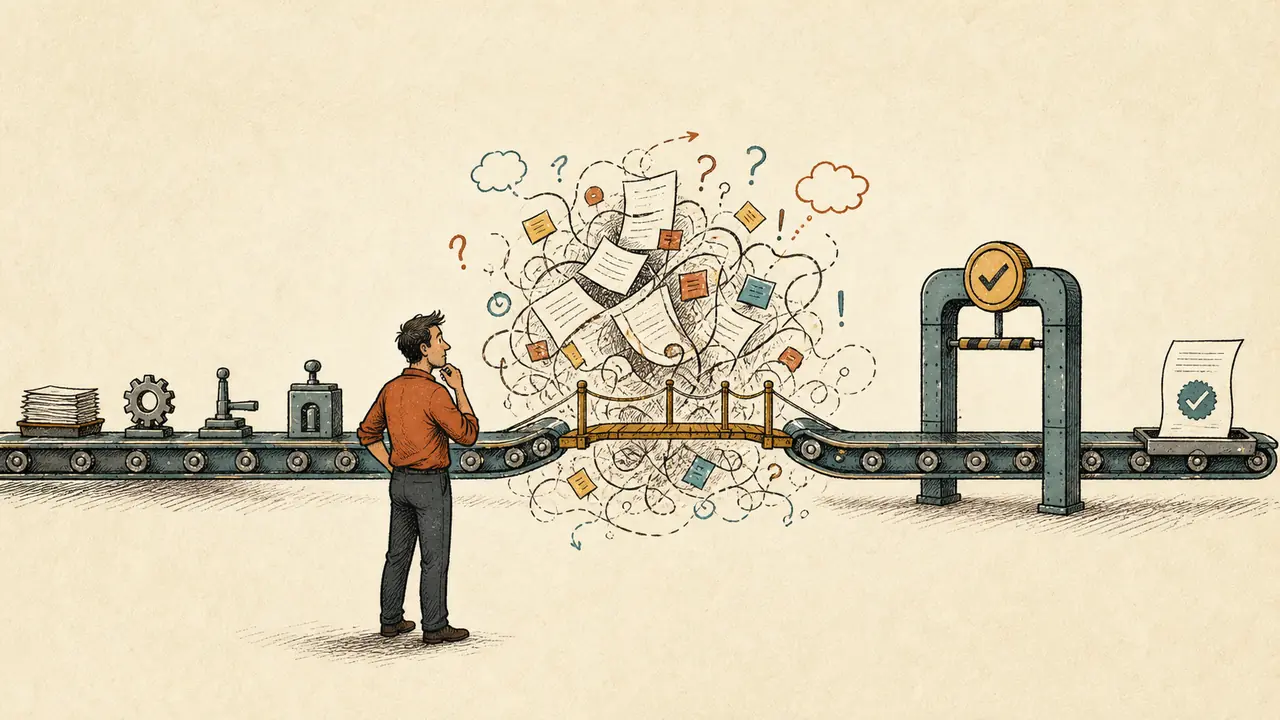
The uncomfortable part of AI workflow automation is not calling a model. It is deciding which part of the job is allowed to be uncertain. A trigger, permission check, database write, or payment should not become probabilistic merely because a model appears somewhere in the diagram.
A useful definition starts at that boundary. AI workflow automation is a process in which software owns the run, a model handles one or more judgment-heavy steps, and the result is accepted, rejected, or escalated against explicit evidence. An agent is one possible component of that process. It is not the definition of the whole thing.
That boundary comes first.
One label hides three execution regimes
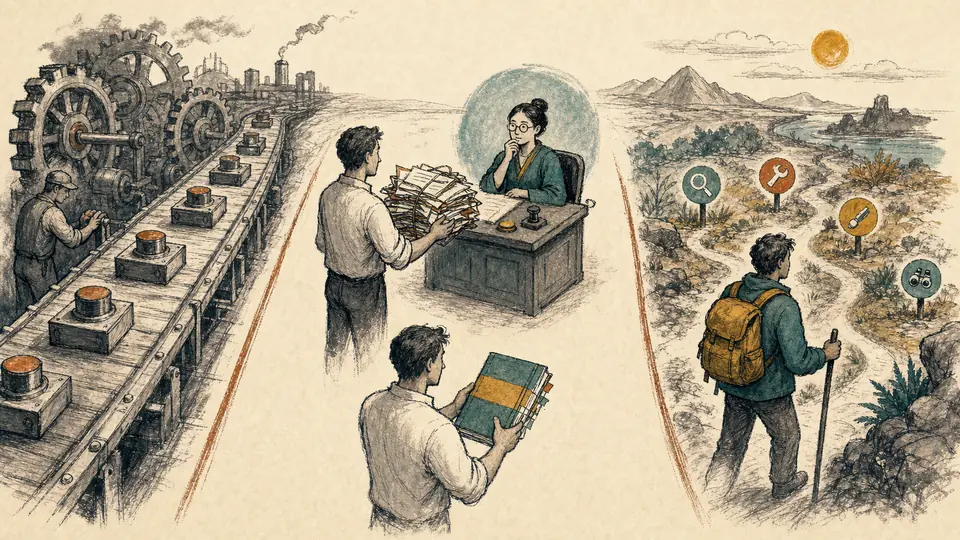
“AI automation” is often used for systems that behave very differently under failure. Anthropic’s engineering guidance draws a clean line between workflows, where models and tools follow predefined code paths, and agents, where the model directs its own process and tool use. There is also a simpler case worth naming: a single model call that enriches an otherwise ordinary application.
Start with the least flexible regime.
| Operating mode | Who chooses the next step? | Where it fits | Main control |
|---|---|---|---|
| Deterministic workflow | Code | Known inputs, branches, and actions | Tests, schemas, and idempotency |
| Model-assisted workflow | Code; the model returns a bounded proposal | Classification, extraction, ranking, or drafting inside a known path | Typed output, evidence checks, and a hold state |
| Agentic loop | The model, using environmental feedback | Investigations where the necessary steps cannot be listed in advance | Tool policy, budgets, checkpoints, and a stopping condition |
The distinction matters because flexibility has a cost. A closed path is easier to reproduce and test. An agent can adapt when the evidence changes, but it can also take an unnecessary turn, compound an earlier mistake, or spend its budget without reaching a decision. The right design uses the least flexible regime that can finish the work honestly.
The control plane is the product
The model is rarely the component that makes a production workflow dependable. The surrounding control plane does that job. It carries an input envelope, a stable run identity, policy, state, approvals, effect receipts, and a final verification record. Replace the model tomorrow and those responsibilities remain.
Five boundaries deserve separate owners:
- Admission: validate the trigger, authenticate the caller, retain the original input, and decide whether the run is eligible.
- Judgment: give the model only the evidence it needs and require a small output contract with an explicit unknown or hold result.
- Policy: decide what may proceed automatically, what needs a person, and what is forbidden regardless of model confidence.
- Effect: apply the approved change through a narrow actuator with a stable operation key.
- Reconciliation: read the destination, attach its receipt to the run, and distinguish complete, incomplete, and ambiguous outcomes.
This arrangement makes a model output behave like untrusted input rather than like a command.
A fluent classification can still fail schema validation. A well-written draft can still refer to the wrong account. Confidence is metadata for routing; it is not permission. The prompt never receives that authority.
A support request moving through the boundary
Consider an incoming support message asking why an invoice changed. The workflow engine can authenticate the webhook, bind the account ID, hash the message, and create a run without AI. A model can then propose a category, urgency, summary, and citations to phrases in the message. Code checks that every required field exists and that cited text actually appears in the source.
If the account ledger contains the expected invoice and the policy defines the branch, the next step is deterministic: prepare a review packet. If the request refers to several systems and the relevant evidence path is not known, a read-only agent may inspect the permitted sources and return findings. It still does not receive the refund tool.
The final actuator accepts a much narrower object: account, invoice, amount, reason, approval identity, and operation key. It does not accept “solve this customer problem.” That separation keeps investigation flexible without making the side effect improvisational.
Reason broadly; write narrowly.
Autonomy and authority are different questions
A twelve-case boundary probe was used for this review. It classified six steps as deterministic, three as closed workflows with model judgment, and three as agentic investigations. Every agentic case was read-only. Two deterministic cases—issuing an approved refund and publishing an approved revision—carried the highest impact.
That result exposes a common design error. Teams often apply strict controls to anything called an agent while allowing a fixed automation to write broadly because its path looks predictable. The real questions are independent:
- May the component choose the next step?
- May it cause an external effect?
A read-only research agent can have wide reasoning freedom and little operational authority. A three-line deterministic function can move money. Tool policy, approval, and credential scope should follow the effect, not the sophistication of the reasoning component.
Failure modes revealed by apparent success
Suppose an approved actuator sends a request and the connection drops before the response arrives. The external service may have committed the change. Re-running the classifier or asking an agent to “try again” does not answer the only question that matters: did operation refund:invoice-4817:v1 already take effect?
The timeout changes the question.
The recovery path is a read. Query the destination by operation key or business identity, compare the remote state with the intended payload, and continue only from the first unverified boundary. If the destination cannot be reconciled, move the run to an explicit ambiguous state. A human hold is cheaper than a duplicate side effect disguised as resilience.
State must outlive the model call
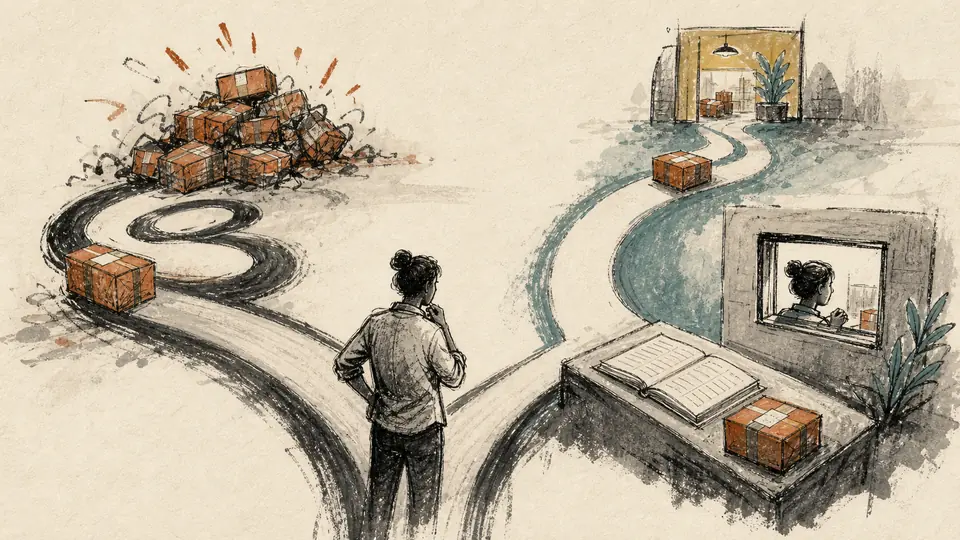
Temporal’s documentation describes durable execution as preserving progress through an event history so a workflow can resume after a crash or outage. The broader lesson applies even when Temporal is not the chosen runtime: state belongs to the workflow, not to a chat transcript or a process that may disappear.
Persistence is not judgment.
A minimal run record should retain the source hash, workflow version, model and prompt version, structured proposal, validation result, policy decision, approval target and payload, operation key, remote receipt, and terminal state. Large reasoning traces are not a substitute for those fields. Operators need the compact facts that determine what may safely happen next.
Durability also changes retry design. Pure inference can usually be recomputed from pinned input. An external read may be repeated with a freshness note. An external write must be reconciled before replay. Treating all three as the same retryable node is how harmless model variability becomes operational duplication.
Choose a tool by failure ownership
A visual workflow engine is a good owner when triggers, integrations, branches, and destinations are known. A durable execution runtime earns its complexity when work waits for hours or days, crosses unreliable services, or must resume precisely after failure. An agent runtime fits when the path itself changes with the evidence—repository investigation, browser research, or a multi-source operational diagnosis.
These components can cooperate, but only one should own each transition. A workflow engine can admit the event and persist state; an OpenClaw worker can perform a bounded investigation with policy-filtered tools; a closed actuator can apply an approved result. OpenClaw’s current documentation makes this separation visible: tools are typed actions, skills provide operating instructions, and effective policy determines which capabilities reach the model.
One transition, one retry owner.
Do not let two orchestrators both believe they own retries. Do not give the investigator a broad write credential merely because integration is convenient. And do not use an agentic loop to imitate a graph that the team can already draw.
Validation before another grant of autonomy
Before adding more autonomy, write down the answers to these questions:
| Question | Architecture consequence |
|---|---|
| Can the next valid step be enumerated now? | If yes, keep path selection in code. |
| Does the model produce a proposal or an effect? | Prefer a proposal; place policy and the actuator after it. |
| Can the proposal be checked against source evidence? | If not, define a hold state before unattended use. |
| Can the destination reveal whether a write succeeded? | If not, the action has an unresolved replay risk. |
| Who owns the operation key and retry decision? | Name one component; shared ownership is duplicate ownership. |
| What stops an open-ended investigation? | Set tool scope, time or iteration budget, and a terminal evidence contract. |
Promote a closed model-assisted workflow to an agent only when real cases show that the required path cannot be predicted. Promote a proposal to an automatic action only when validation, reconciliation, and observed error costs justify it. Those are separate promotions and should not happen in the same change.
Do not collapse the two promotions.
Measure accepted outcomes and recovery debt
Model accuracy alone cannot describe the workflow. Track accepted outcomes, correction rate, hold rate, evidence failures, ambiguous completions, duplicate effects, time to reconcile, and cost per accepted result. Segment the numbers by workflow version and decision type; a healthy average can hide one dangerous branch.
Averages hide branch failures.
NIST’s Generative AI Profile frames trustworthiness across design, development, use, and evaluation. In operational terms, evaluation continues after launch. Sample boring successes as well as escalations, keep a pinned regression set for model or prompt changes, and review whether human corrections are migrating to a new category.
Conclusion: a definition that survives production
AI workflow automation is not a prompt connected to several apps. It is a control system that assigns uncertainty to a bounded reasoning component while keeping identity, policy, side effects, recovery, and evidence explicit.
Use ordinary code for known paths. Use a model-produced proposal when judgment is needed inside a known path. Use an agent when the evidence must determine the path. Then grant write authority independently, through the smallest actuator that can be verified and safely resumed.
For a concrete comparison of closed and agentic paths, see AI Agent vs Zapier. For the control shell around an open-ended worker, see How to Create an AI Agent.
Sources and evidence boundary
- Anthropic: Building Effective AI Agents
- Temporal: What is Temporal?
- NIST AI 600-1: Generative AI Profile
- OpenClaw tools overview
The twelve-case probe tests architecture rules, not production model accuracy. No fixed ROI, implementation time, or reliability rate is claimed. Those depend on the task distribution, model, integrations, approval policy, and the cost of unresolved failures.