2026-11-11
ChatGPT, automation or an AI agent: how to compare offers
Compare ChatGPT, automation and an AI agent on one task: an offer comparison sheet, two operating modes and six checks for businesses in Kazakhstan.

A manager asks for help handling customer enquiries and receives three different answers: “buy subscriptions for your staff”, “we’ll set up automation” and “we’ll implement an agent”. Choosing ChatGPT or an AI agent for business should not start with the total at the bottom of a proposal. The first option may end with an answer in a chat, the second with a saved draft, while the third includes data investigation that nobody requested.
First, align the proposals around one verifiable task and one operating mode. Then establish what the employee does, what is already available in the specific account, what needs connecting and what evidence will be provided before purchase. Only then compare the scope of work. An agent may be a suitable way to carry out the task; its name alone should not make it a mandatory purchase.
This article provides a completed comparison sheet for three options and a set of six checks. It helps remove unnecessary development from an order and reveal work that a subscription does not cover. It does not calculate prices, delivery times or ROI. If you have not yet chosen the process itself, start with the first-task matrix.
Set the same task for all three options
Consider a synthetic trading company in Kazakhstan. It receives emails in Russian and Kazakh, but the first trial requires neither pricing nor CRM changes. The company, enquiries, volume and requirements below are fictional; this is not a GolemWorkers client case or the outcome of a completed pilot.
One shared deliverable: turn an email approved for processing into a verifiable draft enquiry record: product, quantity, city, requested date, missing information and supporting quotations. Do not confirm stock or delivery, set a price or send a reply to the customer. The manager wants to test the work against a hypothetical flow of 20 emails per working day. This is a requirement of the example, not a verified throughput figure for any product.
Specify the operating mode as part of the task:
- Mode A — operator assisted. An employee selects an email approved for processing, starts processing, checks the draft and saves it.
- Mode B — managed flow. An agreed source supplies the emails, the system saves drafts to a designated destination, and an employee checks them. This requires duplicate checks, monitoring for stoppages and a manual fallback procedure.
Do not treat a subscription in Mode A and an integration in Mode B as interchangeable proposals. The first option may be entirely sufficient, but manually selecting the email and saving the result must be visible. If Mode B is mandatory, specify it for every option being compared: supported product capabilities, an integration or a combination of the two may provide it.
ChatGPT has connected apps that provide access to information and supported actions. Eligible accounts also have tasks triggered by supported app events. Availability depends on the app, plan, region, workspace and permissions [1]. An event trigger alone therefore does not establish a need for a separate custom agent. Check the specific account and required source, rather than a screenshot of someone else’s demo.
Complete a comparable-offer sheet
The following are three synthetic task specifications for a contractor or an internal team, rather than three commercial proposals actually received. All must return the same draft. The “not yet proven” row contains questions, not claims about product shortcomings.
On a phone, scroll the table horizontally.
| Comparison field | ChatGPT in a work account | Fixed AI workflow | Agent with restricted tools |
|---|---|---|---|
| Same deliverable | Draft fields with supporting evidence | The same draft | The same draft, without expanding the task |
| Proposed first run | An employee provides text approved for processing | An agreed input triggers predefined steps | The provider demonstrates why choosing subsequent steps is necessary |
| What to check in the specific environment | Availability of the required apps, actions and permissions | Email intake, field extraction, checks and saving | Everything in the previous column, plus the value and limits of planning |
| What counts as evidence | A draft from the supplied synthetic email; visible manual actions | The same output and proof that it was saved to the test destination | The same output and an explanation of added value without unnecessary actions |
| What is not yet proven | Mode B for this account and source | Connection readiness and RU/KK quality | An advantage over a fixed route for this task |
| Provisional decision in the example | Test Mode A first, if acceptable | Test if Mode B is required | Do not commission additional autonomy without a demonstrated advantage |
The sheet makes the scope of delivery explicit, rather than asking “which technology is smarter”. The first option may retain manual operations. The second may require connections to the source and save destination. The third may add complexity without a new result. All three can use a language model; that does not make their service scopes identical.
For this bounded task, the sequence is known: receive text → extract fields → check → save a draft. Under Anthropic’s architectural distinction, this is a workflow; it does not inherently require an open-ended agent loop. Anthropic recommends starting with the simplest sufficient solution [2]. If investigating a discrepancy across several sources becomes necessary later, that changes the task: update the comparison and evidence requirements, rather than automatically adding new work to the original promise.
Separate three different payment categories
ChatGPT and the API have separate billing systems. Some offers may include promotional API credits, so check the terms rather than claiming either “everything is included” or “a subscription never provides any API benefits” [3].
In the order sheet, separate product access, implementation work and ongoing support. Ask who pays for model processing, storage, connected services and the reviewer’s working time. If comparing amounts in KZT, use the same period, volume and scope of work. This article provides no GolemWorkers price list, exchange rate or monetary valuation of hours saved.
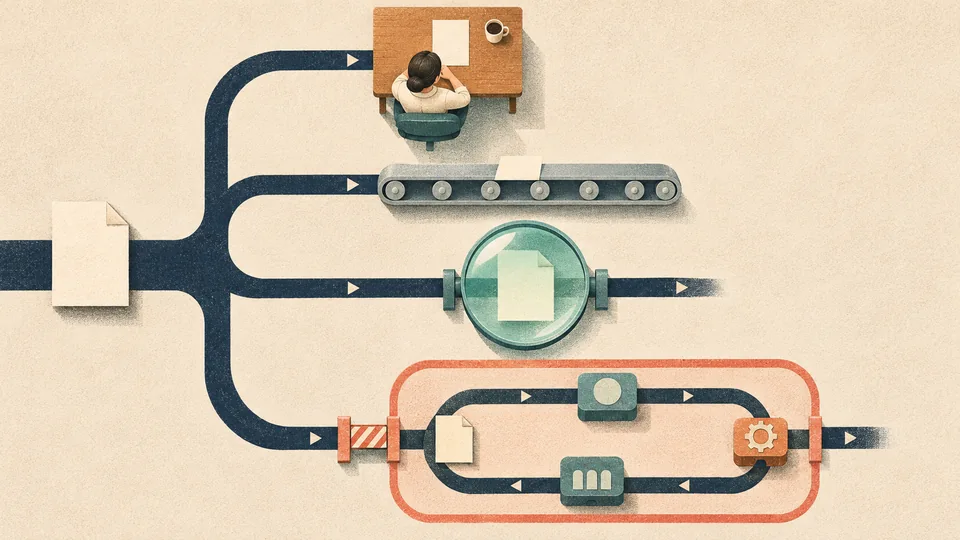
Decision tree: which next step to pay for or test
This tree addresses purchasing and the boundaries of verification; it does not certify the reliability of the chosen technology.
- Do the options promise the same deliverable and operating mode? No → return them for clarification. Do not compare the totals yet.
- Is Mode A acceptable without mandatory automated exchange? Yes → first test the draft in a suitable work account. An integration purchase is not yet justified.
- Is Mode B mandatory? Ask for a demonstration in the specific account: source, action, permissions and output destination. If all are supported, test the built-in capabilities. If any link is missing, give it a separate investigation or integration line item rather than describing a subscription as a complete solution.
- Does the task require understanding free text? If the input is already structured and rules fully describe the transformation, compare ordinary automation without a model. Our email requires interpretation, but the steps follow a fixed order: test a fixed AI workflow first.
- Is there demonstrated additional value in letting an agent choose the steps? If the same task produces only the same draft, do not make agent planning mandatory additional work. If a different investigative task is needed, define a separate verifiable deliverable and limits on authority.
Before any trial, agree on the permitted data and processing environment. If these are undefined, stay with synthetic examples. A product name, the company’s country or the choice of cloud does not, by itself, establish compliance with Kazakhstan law.
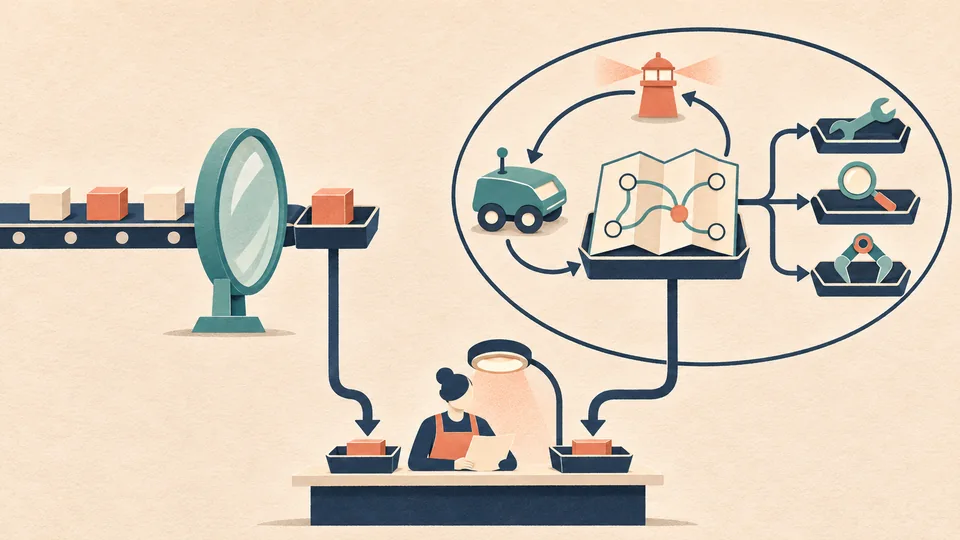
Test the same input, rather than three different demos
Synthetic email in Kazakh: “Сәлеметсіз бе! 15 дана А тауары керек. Астанаға 28 қарашаға дейін жеткізе аласыздар ма?” Russian equivalent: “Здравствуйте! Нужно 15 единиц товара А. Можете доставить в Астану до 28 ноября?” English translation of both specimens: “Hello! We need 15 units of product A. Can you deliver to Astana by 28 November?”
Expected draft: product A; quantity 15; city Astana; requested date 28 November; year and exact SKU unspecified; delivery feasibility unconfirmed. Include a quotation from the email for each field. Price and stock availability are absent. This is a reference for discussion, not an answer actually obtained from any model.
The same input can be tested in three ways. In a chat, an employee supplies the text and manually saves the checked result. A fixed workflow receives the same text from an agreed source and takes it through predefined steps. An agent receives the same goal, but there is no obvious reason here to look for new sources: it too must return the same draft and stop. Using an agent is acceptable, including on a general-purpose platform; a separate charge for additional planning still needs justification.
For Mode B, add six observable pieces of evidence to the comparison, rather than an abstract “accuracy” claim:
On a phone, scroll the table horizontally.
| Check | What the person accepting the work must see | What to do if evidence is missing |
|---|---|---|
| Our source input instead of a prepared demo | Approved test text and its corresponding draft | Do not apply the result of someone else’s example to our task |
| Fields and supporting evidence | 15 units, Astana, 28 November; the missing year and unconfirmed delivery are explicitly flagged | Refine the template and repeat the check |
| The full manual process | It is clear who selected the email, started the work and saved the result | Do not count hidden employee actions as automated |
| The actual output destination | The draft is actually found at the agreed test destination | Separate text generation from an integration that has not yet been verified |
| Retries and a lost response | The provider shows how to establish whether the draft has already been saved | Retain manual reconciliation; do not promise safe repeat creation |
| Both languages and handover to a person | Separate RU/KK examples, mixed-language text and clear behaviour when meaning is ambiguous | Identify the missing check and who is responsible for it |
No row means that a trial has already taken place. In the initial sheet, every evidence item is marked “needs verification”. Six successful synthetic examples would still not establish quality on a live workflow: an approved company dataset and agreed acceptance criteria are then required.
The reviewer must know the relevant language. Matching numbers in the two versions do not guarantee matching meaning. A question about desired delivery must not become a confirmed deadline in either Russian or Kazakh.
Turn the completed sheet into an order scope
In this hypothetical example, the discussion can change the order without any promise of savings. If Mode A is acceptable, the next step is checking the work account and training employees, rather than an integration project. If Mode B is needed and access to the source is unknown, first obtain a verifiable finding from investigating that connection. If the route is fixed, additional agent planning can be removed from the mandatory scope while retaining the selected general-purpose platform wherever it fits.
Ask the provider to distinguish:
- Reusable: the platform, permitted tools, field templates and check templates, once their suitability is confirmed.
- Configurable: the source, draft destination, RU/KK examples, roles and reviewer training.
- Unknown: the specific CRM or 1C version, API availability, permissions, network and recovery after failure. For each unknown, specify what investigation finding would resolve it.
Working on an AX/Windows test environment does not establish readiness for production deployment. One available connection does not establish support for every version and configuration. Do not present draft mode as automatic sending: that is a different deliverable requiring different authority.
Copy the sheet’s six fields before speaking to a provider: same deliverable → operating mode → manual actions → confirmed capabilities → unverified connections → evidence for the next decision. Alongside them, identify who is responsible for verification and what to do if processing stops. Leave unknown fields unknown rather than replacing them with a confident product description.
If the three proposals are still not comparable, describe one task for a GolemWorkers pilot discussion. The application form is in Russian. Attach a description of the deliverable and operating mode, rather than customer documents or passwords. The next step is to determine whether existing capabilities are sufficient and which connections actually need testing; this article promises neither a fixed price nor an implementation outcome.
Sources and limitations
Checked on 11 November 2026 in the original source research. The sheet and trials are an author-created synthetic framework, not a completed product test. No claims are made about search volume, savings, ready-made connectors, SLAs or legal compliance.
- OpenAI: Connected apps in ChatGPT — actions, events, availability and permissions in the specific account.
- Anthropic: Building effective agents — fixed workflows, agents and the simplest sufficient solution.
- OpenAI: Managing billing for ChatGPT and the API platform — separate billing and checking the terms of an offer.